
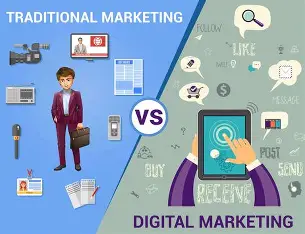
How Digital Marketing is Different from Traditional Marketing.
Marketing is an essential function in any business, shaping how companies attract, engage, and retain customers. Over the past two decades, the landscape has evolved dramatically. The digital revolution has transformed how brands communicate, making it crucial to understand how digital marketing is different from traditional marketing.
Whether you’re a business owner, marketing professional, or curious learner, knowing the key differences can help you make informed decisions for growth. In this blog, we’ll explore how digital marketing is different from traditional marketing, examining strategies, tools, audience engagement, and measurable outcomes.
What is Traditional Marketing?
Traditional marketing refers to offline methods used for decades to reach broad audiences. Common channels include:
Television and radio advertising
Print media (newspapers, magazines)
Billboards and posters
Direct mail and telemarketing
Events and sponsorships
These strategies focus on mass communication, usually through a one-way interaction with consumers. While effective for brand awareness, traditional marketing often lacks precise targeting and measurement.
What is Digital Marketing?
Digital marketing is the modern evolution of promotion, utilizing the internet and digital devices to connect with audiences. Core components include:
Social media marketing (Facebook, Instagram, LinkedIn)
Search engine optimization (SEO)
Pay-per-click (PPC) advertising
Content marketing (blogs, videos, infographics)
Email marketing
Influencer partnerships
Website optimization and analytics
Understanding how digital marketing is different from traditional marketing starts with the channels and data-driven approach used in digital strategies.
1. Targeting and Reach
One of the primary ways how digital marketing is different from traditional marketing lies in its precise targeting capabilities.
Traditional marketing casts a wide net, often reaching people who may not be interested in the product. For example, a TV ad reaches everyone watching a channel, regardless of their intent.
In contrast, digital marketing allows businesses to target specific demographics, interests, locations, and even behaviors. Platforms like Facebook Ads and Google Ads offer granular control, ensuring that content reaches the right people at the right time.
2. Cost-Effectiveness
When comparing how digital marketing is different from traditional marketing, budget is a critical factor.
Traditional advertising, like TV commercials or newspaper spreads, often requires large budgets, making it less accessible for small businesses.
Digital marketing, however, provides options for every budget. Even a modest investment in content marketing, SEO, or social media advertising can yield significant results. This makes digital strategies far more scalable and inclusive.
3. Real-Time Analytics
One of the game-changing aspects of how digital marketing is different from traditional marketing is the ability to track performance in real time.
Traditional marketing lacks immediate feedback. You can’t know exactly how many people viewed a billboard or acted on a newspaper ad.
Digital marketing tools like Google Analytics, Meta Business Suite, and SEMrush allow you to track impressions, clicks, conversions, bounce rates, and more. These insights enable marketers to optimize campaigns as they run, increasing ROI.
4. Customer Engagement
Traditional marketing is largely one-way. You send out a message, and consumers passively receive it.
Digital marketing creates two-way communication. Through comments, direct messages, email responses, and social media polls, businesses engage directly with their audience.
This interactivity is a significant reason how digital marketing is different from traditional marketing. Engagement fosters brand loyalty, encourages feedback, and allows companies to build meaningful relationships with their customers.
5. Content Variety and Flexibility
Another key area how digital marketing is different from traditional marketing is in the types and formats of content used.
Traditional marketing uses static formats—print, radio, or TV—which are difficult to change once published.
Digital marketing allows flexibility in content. You can A/B test headlines, edit videos, update blogs, and optimize web pages—all in real time. From blog posts and podcasts to webinars and memes, the variety in digital content is unmatched.
6. Global vs. Local Reach
Traditional marketing is generally restricted by geography and distribution costs. A flyer can only reach people in your neighborhood, and a TV spot is often local or regional.
Digital marketing, on the other hand, has global potential. A blog post or YouTube video can reach audiences across continents instantly, which is another way how digital marketing is different from traditional marketing.
7. Personalization
Digital tools enable highly personalized marketing experiences. Emails can be tailored based on user behavior. Ads can retarget someone who visited a website but didn’t make a purchase.
This level of customization is impossible in traditional formats, highlighting yet another distinction in how digital marketing is different from traditional marketing.
8. ROI and Measurable Results
Because of its trackability, digital marketing offers a clearer picture of ROI. You can attribute conversions to specific ads, keywords, or channels.
Traditional methods are harder to measure. You might know that sales increased after a radio campaign, but not which specific element drove the results.
This accountability is vital in today’s competitive business landscape, emphasizing how digital marketing is different from traditional marketing.
Final Thoughts
As consumer behavior evolves, businesses must adapt. Understanding how digital marketing is different from traditional marketing equips you with the knowledge to choose the right blend of strategies for your brand.
Traditional marketing still has its place—especially for local reach and brand visibility—but digital marketing offers precision, flexibility, and scalability.
Whether you’re starting a new venture or updating your marketing plan, acknowledging how digital marketing is different from traditional marketing ensures your efforts align with modern consumer expectations and technologies.